8.1.5How does the volume change?

Changing the Axis of Rotation

You have seen a variety of regions revolved around various lines and axes. Today, you will look at the various volumes formed by rotating the same region in different ways

8-49.

EVERY WHICH WAY

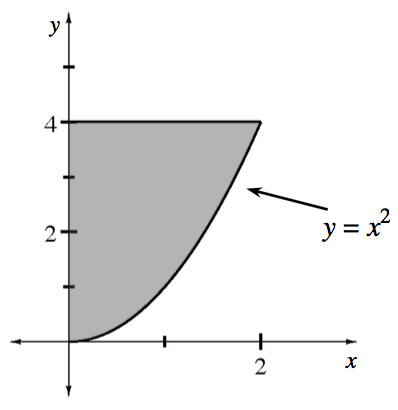
The shaded region shown at right is bounded by the following curves y=x2, y=4, and x=0.

Set up an integral to calculate the volume solid generated when the region is revolved about each line below. Use your graphing calculator to compute the volume.

  1. x-axis

  1. y-axis

  1. y=1

  1. x=3

First quadrant, increasing concave up curve, labeled y = x squared, starting at the origin & ending @ (2, comma 4), with horizontal segment from (0, comma 4) to (2, comma 4), region below segment & above curve shaded.

When calculating volume of a solid, be sure to include the following:

  1.   A rough sketch of the solid.

  2.  A typical slice with dimensions labeled.

  3. The method used (disk or washers).

  4. The integral that will compute the volume.

  5. The volume found by evaluating the integral.

8-50.

Calculate the volume of each solid generated by the following set of bounded curves revolved about each of the axes below.

  1. x-axis 

  1. y-axis 

  1. y=5 

  1. x=1 

  1. y=2 

Bounded Curves
y=2x+1
y=5
x=0

Review and Preview problems below

8-51.

Calculate the volume of the region bounded by y=x, y=0, and x=4 revolved about each of the lines below. Use the steps outlined in problem 8-49. Homework Help ✎

  1. x-axis

  2. y-axis

  3. x=2

  4. y=5

First quadrant, increasing concave down curve, labeled y =square root of x, starting at the origin & ending @ (4, comma 2), with vertical segment from (4, comma 0) to (4, comma 2), region below curve, above x axis, & left of x = 4, shaded.

8-52.

Let y=3x+1, y=0, x=0, and x=2. Calculate the volume of the region revolved about each of the lines below. Homework Help ✎

  1. x-axis

  2. y-axis

  3. y=1

8-53.

When setting up a problem to compute volume by the washer method, explain why πab(R2r2)dx is not equivalent to πab(Rr)2dx. Homework Help ✎